
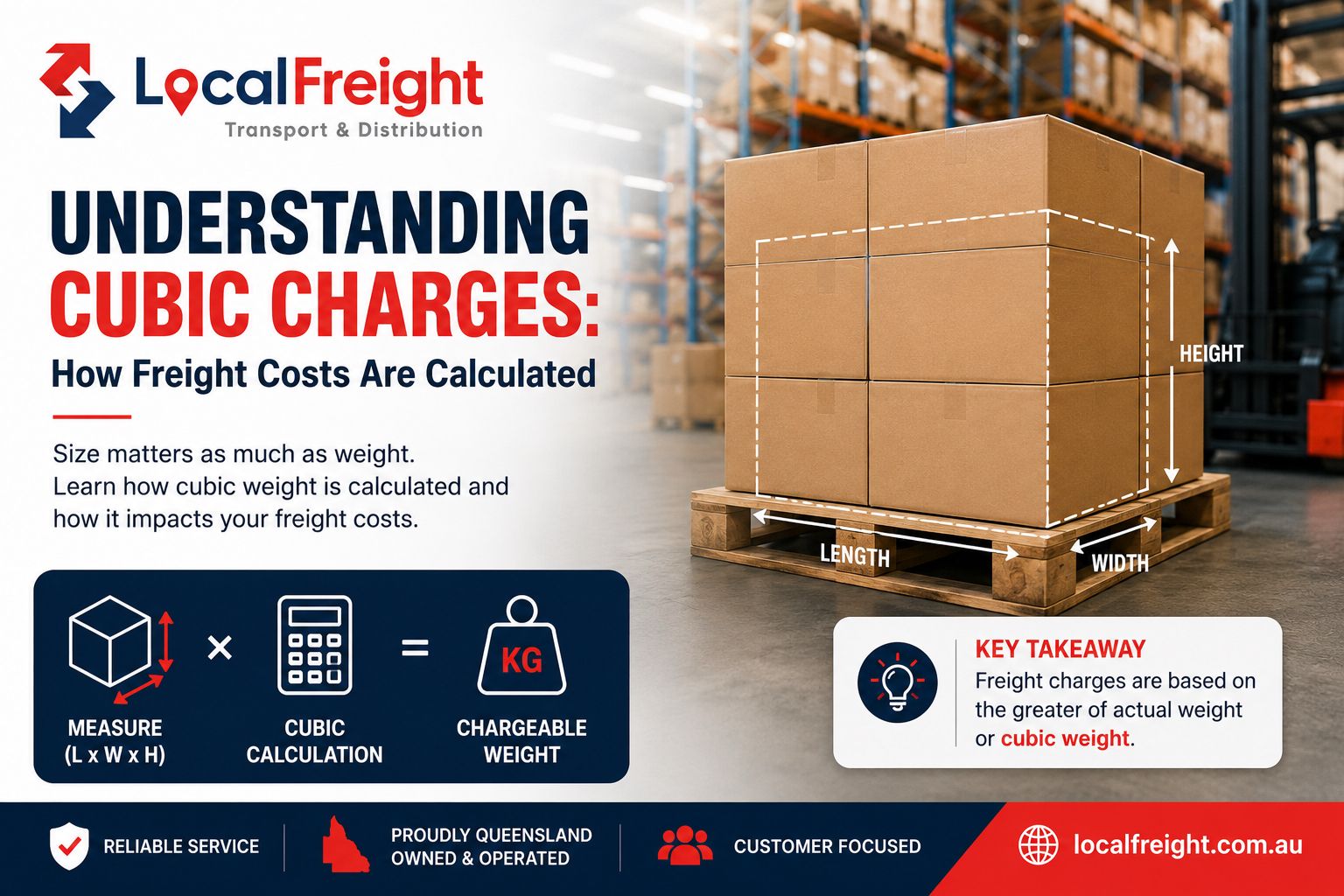

Understanding Cubic Charges: Why Size Matters as Much as Weight in Freight
When booking freight, many businesses assume transport costs are based solely on weight. In reality, freight carriers often charge based on either the actual weight of your shipment or its cubic weight, whichever is greater. This is known as a cubic charge or volumetric charge.
Understanding how cubic charges work can help businesses reduce freight costs, improve packaging efficiency, and avoid unexpected charges on freight invoices.
What Are Cubic Charges?
Cubic charges are freight costs based on the amount of space your shipment occupies within a truck, aircraft, or transport network.
A shipment may be light in weight but large in size. Because it takes up valuable space that could otherwise be used for other freight, carriers often calculate a cubic weight and compare it against the actual weight. The higher figure becomes the chargeable weight.
For example:
- A box of foam products weighing 5kg may occupy the same space as a 30kg carton.
- Even though the actual weight is low, the carrier may charge based on the cubic weight because of the space required.
Why Freight Companies Use Cubic Charges
Transport vehicles have both:
- Weight limitations
- Space limitations
A truck can reach capacity because it is full of large, lightweight items long before it reaches its maximum weight allowance. Cubic charging ensures freight pricing fairly reflects both factors.
Without cubic charging, businesses shipping bulky but lightweight goods would effectively use more transport capacity while paying less than denser shipments.
How Cubic Weight Is Calculated
For most Australian domestic road freight services, cubic weight is calculated using one of the following methods:
Method 1: Using Cubic Metres
- Measure length, width, and height in metres.
- Multiply the dimensions to calculate cubic metres (m³).
- Multiply the result by the carrier’s cubic conversion factor.
Formula
Cubic Weight (kg) = Length × Width × Height × Conversion Factor
Many domestic road freight carriers use a conversion factor of 250kg per cubic metre.
Example
Shipment dimensions:
- Length: 1.0m
- Width: 0.8m
- Height: 0.5m
Volume:
1.0 × 0.8 × 0.5 = 0.4m³
Cubic weight:
0.4 × 250 = 100kg
If the shipment’s actual weight is 60kg, freight charges would typically be based on 100kg because the cubic weight is higher.
Actual Weight vs Cubic Weight
Freight providers compare:
| Measurement | Description |
|---|---|
| Actual Weight, Dead Weight | The physical weight of the shipment on the scales |
| Cubic Weight | The calculated weight based on dimensions |
| Chargeable Weight | Whichever figure is greater |
This means a shipment can weigh only 20kg but be charged as 75kg if its size occupies significant space within the transport network.
Common Freight Types That Attract Cubic Charges
Businesses frequently encounter cubic charging when shipping:
- Furniture
- Display stands
- Packaging materials
- Plastic products
- Foam products
- Empty containers
- Lightweight manufactured goods
These products often have a low density, meaning they take up more space relative to their weight.
Tips to Reduce Cubic Freight Costs
Optimise Packaging
Avoid oversized cartons and unnecessary void space. Smaller packaging can significantly reduce cubic volume and freight costs.
Stack Pallets Efficiently
Poor pallet configuration can increase overall dimensions and therefore increase cubic weight calculations.
Measure Accurately
Freight carriers often use automated dimensioning systems that measure the outermost points of a shipment, including packaging, wrapping, and protrusions. Incorrect dimensions can result in unexpected reweigh and recube charges.
Consolidate Shipments
Combining multiple smaller consignments into a single, efficiently packed shipment can often improve freight economics.
Understanding Different Cubic Conversion Factors
Not all freight services use the same conversion factor.
Typical examples include:
| Freight Type | Typical Conversion Factor |
|---|---|
| Domestic Express Road Freight | 250kg/m³ |
| General Freight | 333kg/m³ |
| International Air Freight | 167–200kg/m³ |
| Sea Freight | 1000kg/m³ |
The exact factor varies between carriers and services, so it is important to confirm the applicable rate when requesting a freight quote.
The Bottom Line
Cubic charges are an essential part of modern freight pricing. While actual weight remains important, the space your shipment occupies can have an even greater impact on transport costs.
By understanding how cubic weight is calculated and taking steps to optimise packaging and pallet configuration, businesses can better manage freight expenses, improve supply chain efficiency, and avoid costly surprises on freight invoices.
For businesses that ship regularly, understanding cubic charges isn’t just about freight calculations, it’s about making smarter logistics decisions that can deliver long-term cost savings.

.png)

.png)


